

Most people walk into a physiotherapy clinic after weeks, sometimes months, of pushing through discomfort. A tight calf that never quite loosened up. A knee that ached after long runs but felt fine the next morning. A shoulder that clicked but didn’t stop them from lifting.
Then one day, it stops being manageable.
What most people don’t realise is that by the time they’re in the clinic, their body has already been fighting for them. Quietly, progressively, and for longer than they think.
The Body’s Defense System: A Timeline Most People Don’t Know About
The human body doesn’t give up on a joint easily. When a joint is repeatedly overloaded through sport, repetitive work, poor movement patterns, or simply doing too much too soon, it doesn’t immediately let the cartilage take the hit.
It works through a sequence. A hierarchy of tissues, each taking on load in turn, each trying to protect the next layer down.
Understanding this sequence changes how you think about pain, and more importantly, when to act.
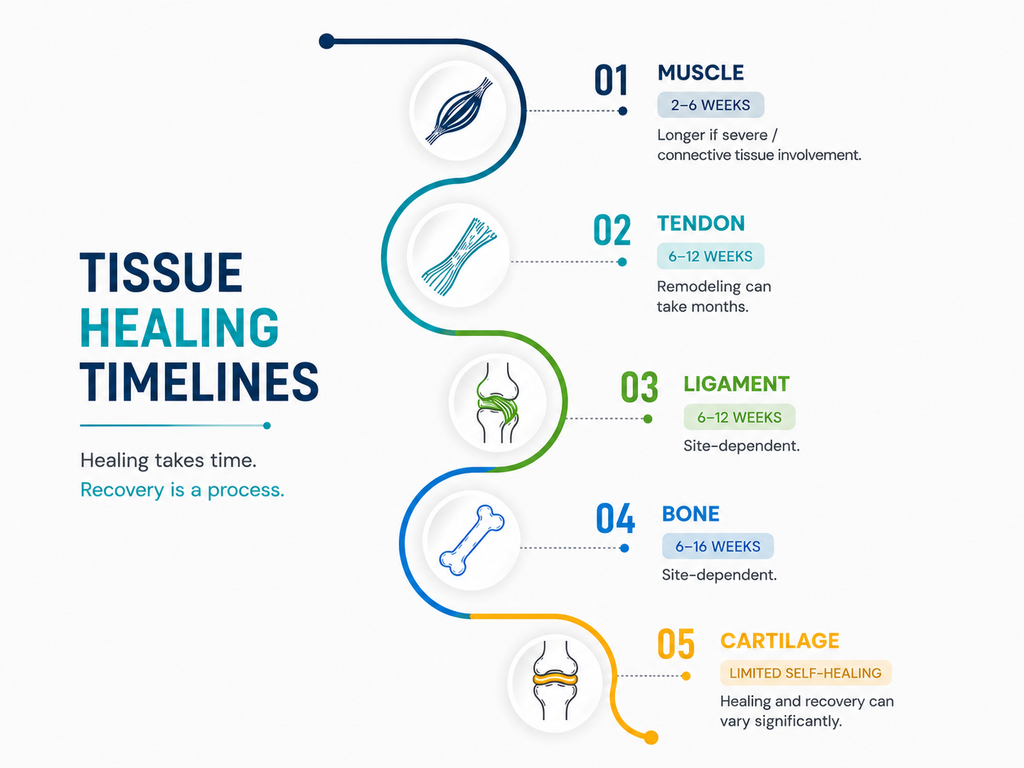
Muscle: The First Line of Defense
Healthy muscle is the body’s primary shock absorber. It absorbs force, controls movement, and distributes load efficiently across a joint. When everything is working well, muscle handles the bulk of what you throw at it.
But muscles fatigue. They can be weak, inhibited, or simply underprepared for the demands being placed on them. When a muscle can no longer adequately manage the load, the body doesn’t stop. It adapts. It passes the responsibility down.
Tendon: When Muscle Capacity Is Exceeded
Tendons are remarkably resilient structures, but they’re not designed to be primary load bearers indefinitely. When fatigued or underconditioned muscles can’t absorb sufficient force, tendons begin taking on disproportionate stress.
This is often where the first warning signs appear: morning stiffness, that familiar ache after activity that “warms up” as you move. Tendon pain is the body saying it’s compensating. It’s managing. But it’s not comfortable with the arrangement..
Ligament: Stability Under Threat
Continued overload, or poor joint control over time, begins to stress the ligaments, the passive stabilisers that hold joints together. Ligaments don’t have the same blood supply or metabolic activity as muscle and tendon.
They heal more slowly. Their involvement in the load-sharing sequence is a sign that the system is running low on options.
Bone: A Deeper Response
Persistent mechanical loading doesn’t just affect soft tissue. Bone responds too, through remodeling, stress reactions, and in more serious cases, stress fractures.
When you see bone involvement, the body has been managing excess load for a significant period of time.
Cartilage: What We’re Working to Protect
Cartilage is the tissue at the end of this sequence, and the one that concerns clinicians most. It has limited blood supply and a notoriously poor capacity for self-repair. Once cartilage is damaged significantly, recovery is slow, management becomes long-term, and in some cases the changes are permanent.
This is why cartilage damage tends to be the last resort the body reaches, and why reaching it represents a meaningful failure of the earlier defense layers.
Why This Matters More Than Most People Realise
“I’ve had this tendon pain for months but it comes and goes, so I’ve just been managing it.”
This is one of the most common things heard in clinical practice. And it’s completely understandable. If something settles on its own, it’s easy to assume the body sorted it out.
Sometimes it does. The body is extraordinarily adaptive.
But recurring muscle tightness and persistent tendon pain are not neutral signals. They are the body’s way of communicating that the current load exceeds its current capacity, and that the compensation strategies it’s relying on have limits.
The danger isn’t the pain itself. The danger is what happens to the tissues further down the chain while the early warning signs are being ignored.
What Physiotherapy Is Actually Doing
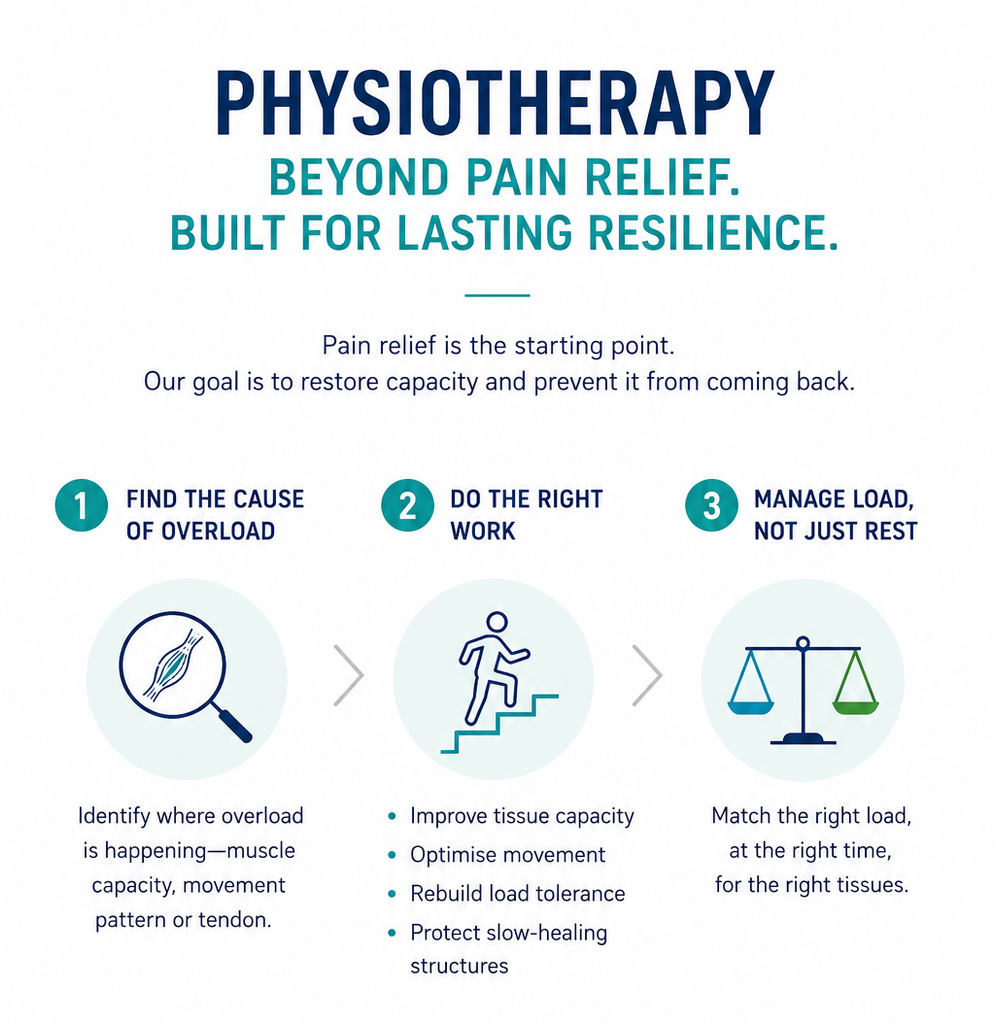
The goal of a physiotherapist working in this space isn’t simply to make the pain go away. Pain relief is a starting point, not a finish line.
The real work is identifying where in the sequence overload is occurring. Is the muscle capacity insufficient for the demand? Is there a movement pattern creating disproportionate load on a particular structure? Is the tendon being asked to compensate because of upstream weakness or stiffness?
From there, the work becomes systematic: improve the capacity of the tissues under stress, optimise movement mechanics, progressively rebuild load tolerance, and protect the structures that recover slowly from ever needing to get involved.
This is load management in its truest clinical sense. Not rest, not avoidance, but the careful calibration of what the body is being asked to do against what it is currently capable of handling.
Physio Active India brings vertical specialists who understand the unique demands of each body part. They look beyond pain to identify what is causing the overload, then build the strength, movement and capacity needed for lasting recovery.
The Best Injury Is the One That Never Happens
Early intervention in musculoskeletal care isn’t about being overly cautious or treating problems that don’t exist. It’s about recognising that the body communicates through a progression, and that the earlier a clinician can intercept that progression, the more options exist for a full, lasting recovery.
The tissue that recovers slowly is cartilage. The tissue that recovers quickly is muscle. The window between those two points is where physiotherapy does its most important work.
If something has been recurring, if the tightness keeps coming back, if the tendon never quite settles, that is the window. That is the right time to act.
Not when it becomes unbearable. Not when the cartilage finally runs out of defenders
Experiencing recurring muscle tightness, tendon pain, or joint discomfort that keeps returning? An early assessment can identify where the overload is occurring, before it progresses to tissues that are far harder to treat. Book a session with our physiotherapy team today.
Reach out to us to schedule a session:
WhatsApp / Call : 9971879090
Email: info@physioactiveindia.com
In case you need personal consultation, feel free to book a session with us today
Schedule the session from our website

This clinical perspective is inspired by the insights shared by Dr. D M Manoj on LinkedIn. For more detailed medical discussions, you can view the original professional thread here.