
There’s a version of healthcare that most people understand instinctively. You come in with a problem. The clinician assesses it. They treat it. You get better. You come back if it happens again.
It’s a clean, logical loop. And for a lot of conditions, it works exactly like that.
But sometimes the most honest and helpful thing a clinician can offer a patient is not another treatment session. Sometimes it’s a conversation. And sometimes, it’s the courage to say: you don’t need more of this.
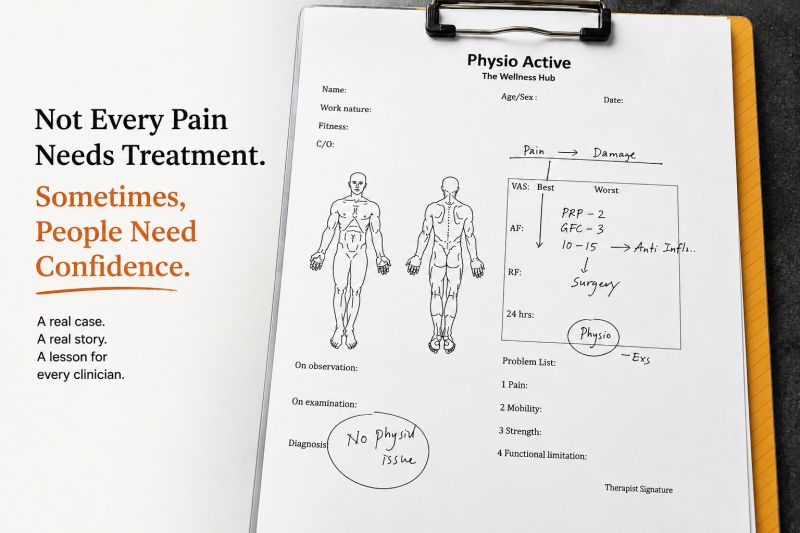
A Patient who had already had Everything Done
A few weeks ago, a patient walked back into the clinic. She had been treated here almost four years ago for an ankle ligament injury, made good progress and then moved cities. Contact was lost.
What she described in those four years was striking.
Two PRP injections. Three GFC injections. Somewhere between ten and fifteen local injections around the ankle. And then, six months ago, a surgical reconstruction of the ankle ligament. She had completed rehabilitation after the surgery. Her ankle was structurally repaired.
She still had burning pain and discomfort.
The first instinct in a situation like this is clinical: assess, find what’s wrong, prescribe. That’s what physiotherapists are trained to do. But sitting with her story, something else became clear.
This ankle had been treated, injected and operated on repeatedly over four years. Each intervention sent the same quiet message: something is still wrong. You are still broken. You still need fixing.
And here she was, four years later, looking for the next thing that might finally work.
When Treatment becomes the Problem
Pain is not a simple signal. It isn’t just tissue damage announcing itself through nerve endings. Pain is a complex experience shaped by biological, psychological and social factors simultaneously. The International Association for the Study of Pain recognises a category called nociplastic pain, where pain persists not because there is ongoing tissue damage, but because the nervous system has become sensitised to threat in a way that outlasts the original injury.
This is not imagined pain. It is a real pain. But the tissue problem, which in this case had been surgically addressed, no longer adequately explains it.
Continuing to treat symptoms in this context carries a specific risk. Every appointment, every modality, every fresh intervention reinforces a particular belief in the patient’s mind: my body is still damaged. I am not safe to move normally. I need someone to fix me before I can get back to my life.
That belief, held long enough, becomes part of the problem itself.
The decision for this patient was to not prescribe another round of physiotherapy. Not because her pain wasn’t real. Not because there was nothing to offer. But because more treatment, at this point, risked deepening the very dependency that was holding her back.
What the Conversation looked like Instead
What followed was not a treatment session. It was a conversation about pain, about movement and about what her ankle was actually capable of now.
The message was straightforward. The ankle had been through a significant journey. It had been repaired. It was structurally sound. And it could move, load and get stronger. Not one day in the future when the last trace of discomfort disappeared. Now.
She was encouraged to walk progressively. To load the ankle. To exercise. To stop waiting for someone to clear her before resuming her life. Chronic pain guidelines, including those from NICE are consistent on this point: staying physically active and using movement as part of management produces better long-term outcomes than passive treatment when no underlying structural condition adequately accounts for the ongoing symptoms.
The goal was not to discharge her and wish her luck. The goal was to make sure she left with a different understanding of her situation than the one she arrived with.
Her ankle could move. Her ankle could load. Her ankle could get stronger. And she didn’t need another injection or another procedure to start believing that.
The harder Clinical Skill
Physiotherapy training covers assessment, treatment techniques, rehabilitation protocols, modalities and clinical reasoning. What it covers less explicitly is knowing when to stop.
This is the harder skill. Not because stopping is passive. It requires as much clinical reasoning as starting. It requires a thorough assessment to confirm that the tissue problem is no longer the primary driver. It requires understanding pain science well enough to explain it clearly and compassionately to a patient who has been in pain for years. And it requires the confidence to hold that position when the patient’s instinct is to keep looking for something more.
The risk of continuing to treat unnecessarily is not abstract. It is a real clinical phenomenon. Patients who receive repeated interventions for symptoms that have outlasted their structural cause often develop stronger pain behaviours, greater fear of movement and more entrenched beliefs about their bodies being damaged. This is sometimes called iatrogenic harm, harm that comes not from negligence but from treatment itself, well-intentioned treatment that inadvertently reinforces the wrong message.
What this means for Patients
If you have been dealing with pain for a long time, through multiple treatments, injections, or procedures and you are still searching for the thing that finally resolves it, this is worth sitting with.
It does not mean your pain is not real. It is.
It does not mean you were treated badly or that the previous interventions were wrong at the time.
But it might mean that the most useful next step is not another modality. It might be a different kind of clinical conversation. One that focuses less on what is still wrong and more on what your body is now capable of. One that reframes the goal from being pain-free before moving to moving as the path toward less pain.
At Physio Active, this kind of approach to recovery sits at the centre of how we work. Understanding what the body needs at each stage of healing, which sometimes means more treatment and sometimes means more confidence, is what separates genuine rehabilitation from an endless cycle of intervention.
Less intervention. More life.
The best outcome for any patient is not that they keep coming back. It is that they leave with enough understanding of their own body to live well without needing to.
Sometimes that happens through structured rehabilitation. Sometimes through targeted treatment of a specific condition. And sometimes it happens through a single honest conversation that changes the story a patient has been telling themselves about their own pain.
All three are physiotherapy. The third one just looks different from what most people expect.
Dealing with pain that has persisted through multiple treatments and not finding lasting relief? A thorough assessment can help clarify what your body actually needs at this stage. Book a consultation with our team.
Reach out to us to schedule a session:
WhatsApp / Call : 9971879090
Email: info@physioactiveindia.com

This clinical perspective is inspired by the insights shared by Dr. D M Manoj on LinkedIn. For more detailed medical discussions, you can view the original professional thread here.